No immediate fiscal impact does not mean identical payment rules
Kern County’s proposed replacement CAL FIRE operating plan changes reimbursement treatment as a wildfire moves past two hours and then into its next operational period. Its backfill provisions automatically authorize coverage for 50% of assigned county Gray Book stations during extended and major incidents, while additional coverage requires state approval. Those conditions matter even though the October 13 agenda labels the amendment’s immediate fiscal impact None.
What’s the Scoop With Broach examined the 125-page packet, comparing the reimbursement chapter, incident-order reconciliation, specialized-resource exceptions and billing provisions. Our finding is a map of the payment conditions in the replacement plan, not a claim that every provision is newly introduced compared with the prior exhibit. We did not obtain the superseded exhibit for a complete redline.
The Fire Department’s staff letter says Kern provides protection for 1,642,600 acres of State Responsibility Area and describes substantial changes and additional county resource commitments. It also says payments remain subject to the original agreement’s $188,000,188 contractual maximum. That ceiling is not the amount this amendment newly appropriates, nor evidence of payments actually received.
The incident clock and resource type both matter
The reimbursement chapter defines initial attack as incident start through the two-hour mark. Gray Book resources are already funded under the agreement; their equipment costs are not reimbursable in that initial period. For other state-approved or Appendix A preapproved resources, excluding the separate crews, dozers and aviation rules, the plan pays unplanned overtime but not equipment costs.
From two hours until the next operational period, the extended-attack rules retain unplanned-overtime treatment for Gray Book resources and exclude their equipment costs. But engine-equipment costs become reimbursable for the specified state-approved non-Gray Book or Appendix A resources. During the major or multi-operational stage, starting with the next operational period, Gray Book unplanned overtime and equipment costs are reimbursable, while approved non-Gray Book or Appendix A resources are paid as assistance by hire.
That is why an account describing all early firefighting as unpaid would be wrong. County-funded crews and dozers have dispatch-time reimbursement rules, and Appendix A aircraft have personnel and aircraft-operating provisions from initial dispatch. The plan expressly treats these resources separately. It also says reimbursement is calculated by each incident period and is not retroactive unless otherwise stated.
The 50% provision is a payment authorization, not a staffing ceiling
In the extended- and major-incident provisions, immediate backfill approval covers 50% of the assigned county Gray Book stations. The county may locate that backfill where it sees fit. Further reimbursable backfill can be approved by the state duty officer or agency representative when multiple or extended wildfires and resource drawdown justify it.
The denominator is assigned Gray Book stations—not half of all Kern fire stations or half of every engine dispatched. Nor does the text prohibit Kern from arranging other coverage with other funding. Payment stops when the Gray Book engines are released or available at the scene, and reimbursable backfill personnel must complete an activity report.
Out-of-county assignments directly requested for a state mission use a different approach: assistance-by-hire billing from dispatch, with no separate backfill authorization because the county rates incorporate backfill costs. Treating those assignments as though they carry the same additional backfill payment would count a cost component twice.
Two deadlines run from different events
Ordinary approved state-mission billing must be submitted within 180 days of the incident control date. Qualifying federal Fire Management Assistance Grant reimbursement instead has a 90-day deadline measured from the FMAG eligibility close date, with a written extension request allowed for cause for no more than 30 additional days. The 90-day figure is not simply a shorter period beginning on the same day as the 180-day figure.
The plan says the state shall approve county invoices within 60 days of receipt and provides for a written good-cause extension. It also provides a contact procedure for nonpayment after 60 days. Those clauses do not establish that every claim will be paid within 60 days, regardless of eligibility, documentation or correction needs.
Before incident closeout, state and county representatives are to reconcile resource orders, validate order and request numbers, identify the official who authorized each state expenditure, and resolve discrepancies. This creates a documentary test for reimbursement. The packet contains rules and forms, not a ledger proving Kern has submitted every eligible claim or lost money through a missed deadline.
The practical accountability check
The department’s stated purpose is cooperative protection, and the plan recognizes closest-resource deployment and operational readiness. It also says the state will not arbitrarily deny a county reimbursement request and must consider operational needs. These are material protections alongside the approval conditions, not evidence of a blanket refusal to reimburse.
The public test after an incident is specific: match each resource to its funding class, incident stage, authorization and submission deadline before comparing claimed and paid amounts. Our original contribution is that cross-clause comparison. The October 13 agenda and county-issued recap were rechecked October 19; the recap does not identify this amendment’s final vote, so this report analyzes the submitted replacement plan without asserting execution or continued pendency. No firefighter interview, incident observation or independent invoice audit was conducted.
Sources and further reading
Official October 13 morning agenda, item 29 ↗
County-issued October 13 meeting recap ↗
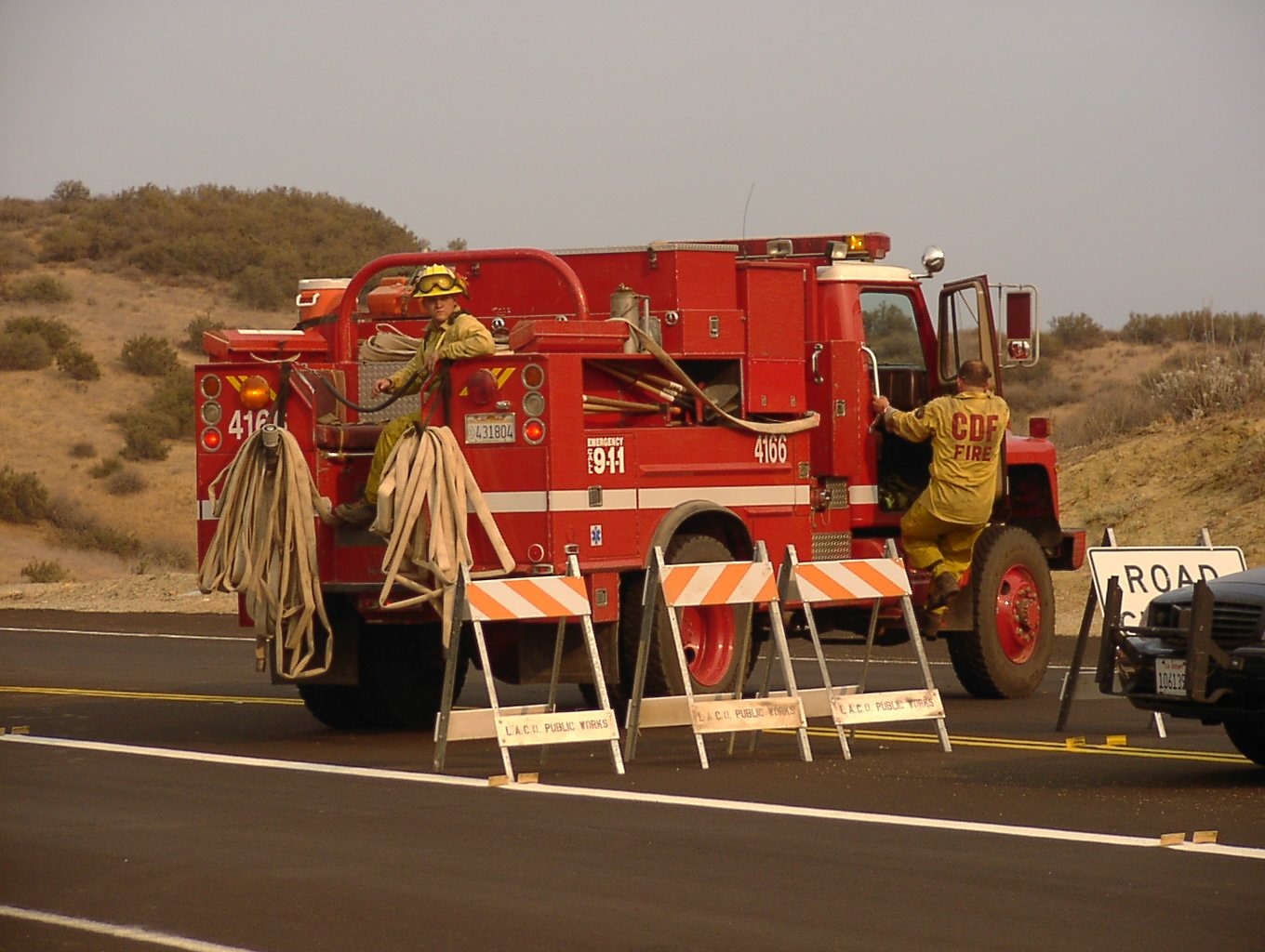
Photograph source and attribution: Slofirefighter/Wikimedia Commons ↗
Photograph reuse terms: Public domain — dedicated by photographer ↗