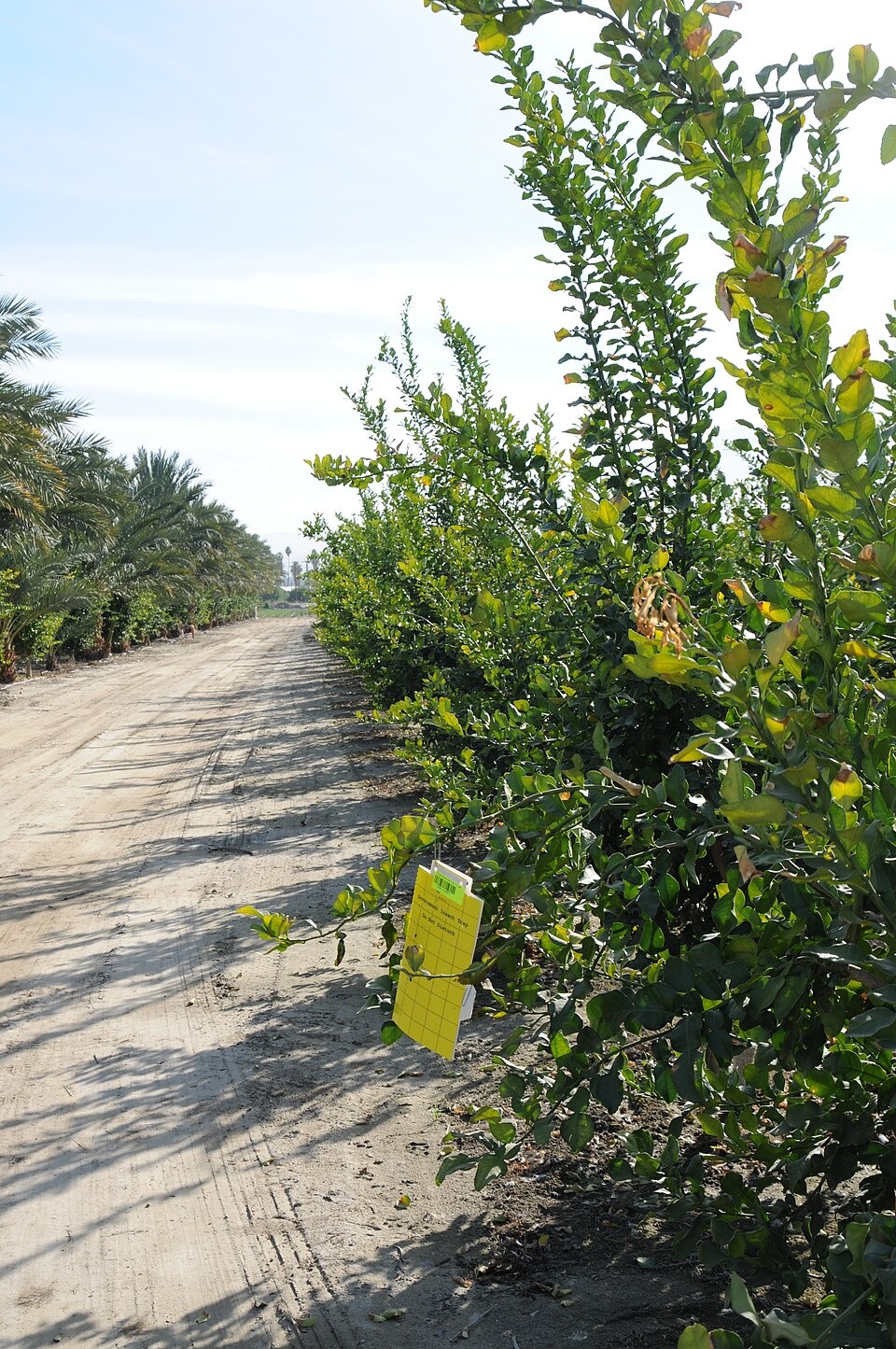
The denominator behind the detection award
Kern County’s proposed $360,000 Asian citrus psyllid detection agreement contains worksheets totaling 26,398 planned trap-servicing events over October 2026–September 2027. That is not a promise to deploy 26,398 different traps. What’s the Scoop With Broach reconstructed the monthly rows and the accompanying hours formulas, then compared the detection agreement with a separate $65,000 quarantine-enforcement agreement.
The distinction is material to public oversight: repeated inspections of the same trap are services, while deployed traps measure the field network at a particular time. The contract defines a servicing as inspecting a trap for the target pest and counts a relocation as a servicing. It specifically says not to count a relocation as both removal and placement.
Together the two proposed agreements have $425,000 in maximum funding. Detection accounts for 84.7% and regulatory work 15.3%. Both cover October 1, 2026–September 30, 2027, but their scopes and reporting requirements differ. Combining their dollars does not mean their activity counts can be combined into one trapping total.
Reconstructing two worksheets
For October 2026–June 2027, the detection worksheet lists 1,951 detection trap servicings for October, 2,015 for November and 2,160 in each of the following seven months. Those rows total 19,086 detection servicings. Delimitation entries add 491 in October and 341 in November, totaling 832. The nine-month worksheet therefore totals 19,918 events.
The July–September worksheet adds 2,160 detection trap servicings in each month, or 6,480. Its delimitation and commercial rows are zero. Adding 19,918 and 6,480 gives 26,398 planned events for the agreement year: 25,566 detection servicings and 832 delimitation servicings. The recurring 2,160 rows demonstrate why summing the annual work count cannot establish the number of distinct traps, unique properties or acres covered.
The worksheets convert the servicing counts into field hours and then add 10%. Their printed totals are 3,810.40 hours for the first nine months and 1,239.65 for the last three, or 5,050.05 field hours. The explanation says the financial plans separately include nondetection work such as supervision and administration. The field-hour total should not be presented as all employee time charged to this agreement.
A budget ceiling is not a unit price or a completed result
The financial schedules divide the detection budget into $269,540 for nine months and $90,460 for three months. Those amounts reconcile exactly to the $360,000 agreement maximum. They cover more than the physical act of looking at a trap, including personnel, benefits, overhead and vehicle costs. Dividing the ceiling by the planned servicing count would not produce a contracted price for one trap or a verified cost per pest found.
The detection scope ordinarily calls for monthly inspection of detection traps, with delimitation inspection frequency depending on the situation and district-manager direction. Unique trap numbers, location records, daily trapping summaries and monthly activity reports provide the audit trail needed to distinguish network size from repeated activity.
The separate quarantine agreement prioritizes regulatory and records inspections at regulated establishments over issuing compliance agreements. Its work includes growers, packers and processors, transporters, sellers, harvesters, disposal and tracing activities. Those services address movement and regulatory compliance, rather than supplying another $65,000 to the same trap-servicing worksheet.
The paperwork is a payment control
Detection invoices must be accompanied by monthly detection activity documentation; claimed employee hours must match the documentation, and payment is monthly in arrears after approval. The scope requires submission within 30 calendar days after the work month and says even amended invoices must arrive within 30 days after agreement expiration. The contract also permits state and federal quality-control field inspections with 48 hours’ notice.
For quarantine work, monthly itemized invoices and regulatory activity reports are due within 30 days after the reporting period. Invoices are not paid until CDFA receives and verifies the report; personnel hours must match the invoice. These are distinct documented controls. The records reviewed do not establish that Kern has failed them or that a listed planned activity has already occurred.
Agriculture staff attributes the retroactive requests to CDFA’s review process and timelines. We checked both scanned packets, including the physical worksheets and financial totals, against the official October 13 agenda and county-issued recap on October 19. The recap does not identify these items’ final votes; we do not infer execution or continued pendency. Our original contribution is the event-count reconstruction and the comparison of the two funding and verification systems, not an orchard inspection, an independent pest survey or a finding about current infestation levels.
Sources and further reading
October 13 AM item 13: complete 29-page quarantine/regulatory agreement and work plan ↗
Official October 13 morning agenda, items 12 and 13 ↗
County-issued October 13 meeting recap ↗
Photograph source and attribution: David Bartels/USDA ↗
Photograph reuse terms: Public domain — U.S. government work ↗