Where the grant is actually directed
Updating Kern County’s emergency operations plan and partially financing accessible public alerts account for $241,098 of a $281,882 emergency-management grant appropriation request, or 85.5%. What’s the Scoop With Broach reconstructed all five project amounts in the October 13 Fire Department packet and reconciled them with its accounting entries rather than treating the grant as an undifferentiated emergency-response windfall.
The largest commitment is $134,235 for a consultant to update the Kern Emergency Operations Plan, 47.6% of the grant. Another $106,863, or 37.9%, partially funds the third- and fourth-year service agreement with Deaf Link for American Sign Language interpretation and Spanish translation of ReadyKern alerts and warnings. The packet does not say this grant pays the entire service agreement or starts a new alert service.
The accountability question is what the advertised grant amount purchases, what local resources it requires, and what the public can check after authorization. The records establish a concentrated plan-and-communications allocation; they do not establish that consultant services are unnecessary, that accessible alerts are ineffective, or that the work has been completed.
A dollar-for-dollar match is not a second new appropriation
The grant requires a $281,882 local match. Combining that amount with the federal award produces $563,764 in grant-plus-required-match value, not $563,764 of new federal money. The department explicitly says appropriations for the county’s matching costs are already included in its approved budget. Adding the match to the request and calling the result a new October spending increase would double-count existing budget authority.
There is a second classification trap. The agenda’s fiscal-impact line labels the revenue State, while the staff letter identifies the origin as the U.S. Department of Homeland Security, passed through the California Office of Emergency Services. The accounting attachment records the entire $281,882 under Federal Aid–Other. Read together, these describe federal pass-through funding administered through the state, not two independent grants.
The grant is identified as fiscal 2025 and has a July 1, 2025–June 30, 2027 performance period. The October 2026 appropriation request is therefore not evidence that every supported activity begins in October. Staff says supervisors authorized application documents, designated agents and retroactive award-letter signatures on April 28, 2026. We report that chronology as the department’s account, not as a separately audited record of earlier spending.
The remaining projects reconcile to the ledger
The remaining $40,784 consists of $34,784 for Emergency Operations Center audiovisual maintenance, $3,500 for emergency-management training for center staff, and $2,500 for rental space for disaster-equipment trailers in the Kern River Valley. Those three amounts plus the plan consultant and Deaf Link allocation sum exactly to $281,882.
The budget attachment groups $106,863 in professional/specialized services and data processing, and $175,019 in special departmental expense. The former exactly matches Deaf Link’s project allocation; the latter exactly matches the other four projects combined. That reconciliation gives readers a way to connect the broad accounting categories to the staff letter’s specific uses. It does not identify final vendor invoices or certify their eligibility.
The Fire Department says Cal OES approved these projects and describes them as improving preparedness and response. Spending on an operating plan, communication access and maintained equipment is consistent with that stated purpose. A personnel- or service-heavy allocation is not, by itself, evidence of waste.
An appropriation is not a measured preparedness result
The public packet does not include the consultant’s detailed deliverables, a completed plan revision, the full Deaf Link contract price, alert-delivery testing, or records showing how much of the local match has been credited. It therefore cannot establish a cost per successfully warned resident, a completed training count, or whether the required match has actually been satisfied. Those are distinct performance and accounting checks, not conclusions supplied by the award’s title.
Our original contribution is the five-project sum, the two-project concentration calculation, the reconciliation to two ledger categories, and the separation of new grant authority from existing matching appropriations. We read the four-page packet, visually checked its scanned staff letter, and checked the official meeting agenda and county-issued recap on October 19. The recap does not identify this item’s final action; we do not infer either approval or continued pendency from that omission. No interview, emergency-center visit or review of private accounting records is claimed.
Sources and further reading
Official October 13 morning agenda, item 28 ↗
County-issued October 13 meeting recap, distributed by Public Technologies ↗
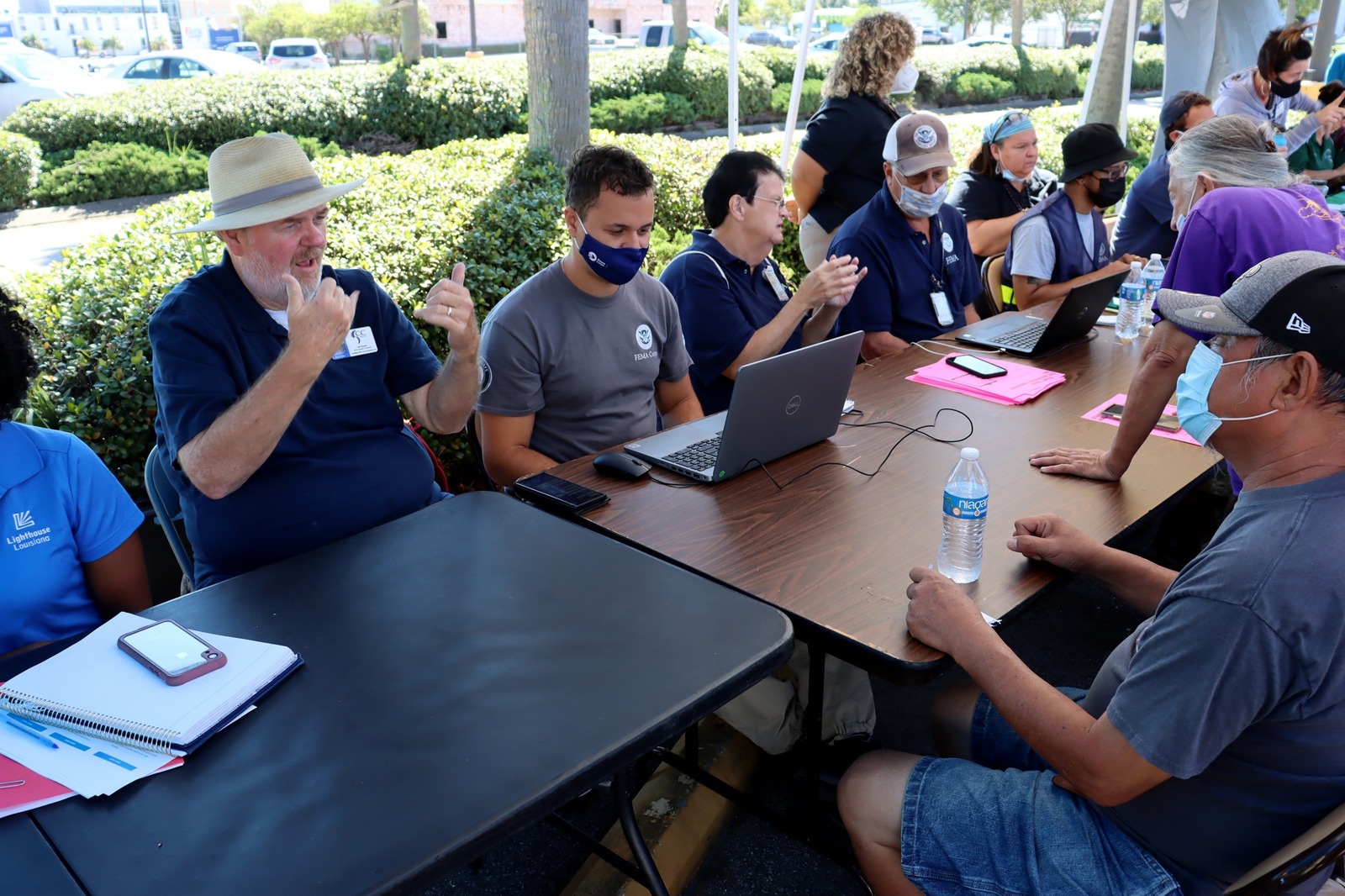
Photograph source and attribution: Keith Jones/FEMA ↗
Photograph reuse terms: Public domain — U.S. government work ↗