One headline total, two different evidentiary tests
A federal audit’s roughly $455 million headline for Wisconsin school-based Medicaid combines two materially different findings. What’s the Scoop With Broach’s examination of the full report, its statistical appendix and Wisconsin’s written response finds that about 85.3% of the combined amount carries an explicit opportunity to supply supporting records rather than refund the money.
HHS’s inspector general recommends refunding an estimated $67,042,719 related to unsupported time-study coding and provider-licensure documentation. Separately, it recommends that Wisconsin support its allocation of health-service costs to Medicaid or refund $387,870,393. Those figures sum to $454,913,112; the second divided by that sum is 85.3%. Neither this calculation nor the audit establishes that $455 million was stolen, that every service was fictitious, or that a final repayment has occurred.
The accountability question is whether Wisconsin can demonstrate the portion of school-health spending properly charged to the federal program without conflating missing allocation evidence with proven nonexistent care. The answer in the September 30, 2026 audit remains divided: auditors identified specific unsupported sample items, but most of the dollar exposure comes from a broader inability to verify a cost-allocation ratio.
The arithmetic avoids double counting
The review covers July 1, 2018 through June 30, 2022, not current school-year billing. Wisconsin claimed $505,513,513 in federal reimbursement: $415,887,146 for health services and $89,626,367 for administrative activities. The questioned combined amount is about 90.0% of that historical federal total, but it should not be described as a 90% proven fraud rate.
The report’s footnote 16 explains the largest figure: $415,887,146 in health-service claims minus $28,016,753 in estimated unallowable health-service reimbursement equals $387,870,393. Thus the inspector general removed the estimated health-service overpayment before identifying the additional unsupported allocation amount. Adding the original $415.9 million to the $67 million would double count part of the finding.
The $67 million recovery recommendation is itself a conservative statistical estimate: $28,016,753 for health services plus $39,025,966 for administrative activities, using lower limits of two-sided 90% confidence intervals. It is not the raw dollar value of 300 individually inspected invoices. The sampled units were combinations of a time-study moment and a school district.
Small administrative pool, larger sampled documentation problem
The publication also compared the audit’s sample denominators with its final unsupported-moment counts. Auditors examined 195 health-service moments and 105 administrative-activity moments. The report identifies 22 unsupported health-service moments and 60 unsupported administrative moments: approximately 11.3% and 57.1%, respectively. These are descriptive shares of a stratified sample, not independently estimated statewide error rates.
Administrative activities account for only 17.7% of the audited federal dollars, yet the administrative component accounts for 58.2% of the $67 million minimum estimated overpayment. That comparison identifies a distinct documentation problem within the smaller spending stream. It does not establish which school district owes a particular refund or that administrative work provided no benefit.
The two streams also had different distribution rules during the audit period. According to the report, Wisconsin paid districts 60% of final health-service cost settlements and retained 40%; for federal administrative reimbursement, districts received 90% and the state retained 10%. Applying either percentage to the entire $455 million would be misleading because the health figure concerns total claims, not just final settlements.
Wisconsin contests the standard; one correction changed the audit
Wisconsin generally disagreed with the findings. It argued that contractor coding was largely accurate, that CMS had approved its use of self-reported individualized education program ratios, and that collecting every student’s sensitive records would raise privacy concerns. It agreed that some sampled moments needed additional follow-up and described changes to coding and its Medicaid plan.
The response made a demonstrable difference: auditors reversed one licensure finding after checking that a speech-therapy provider was licensed under a previous name, then revised their estimate and financial recommendations. They maintained the remaining findings. On allocation documentation, auditors said CMS considered redacted or masked student information a possible way to preserve privacy while permitting verification.
A separate check of CMS’s published Wisconsin amendment WI-25-0014 confirms approval on August 18, 2025, effective July 1, 2025, with expanded school-based coverage and payment details. Its approval is later than the audited claim period; it is not proof that historical questioned claims have been substantiated or repaid. The audit also identifies omitted beginning-of-school-year time-study days but says their financial effect could not be quantified, so we add no extra dollar estimate for that issue.
The audit also warned that newer denominator definitions differed. The separately posted CMS amendment describes the denominator as all students with an IEP on approved pages 16.e-2 and 16.e-7. That wording differs from the audit’s description of the amendment. These two records do not independently establish how the current implementation resolves that issue; approval alone is not certification that the allocation-documentation problem was repaired.
Method and current-status limit
This is original public-document analysis, not firsthand school observation or an independent clinical audit. We reconciled the full inspector-general report’s claim totals, footnotes, sample design, estimated recoveries and state response, checked the arithmetic, and read the separate CMS amendment. The distinctive contribution is to distinguish the conditional 85.3% of the dollar total, avoid the overlapping-dollar trap and compare the smaller administrative pool with its sample findings.
As of October 14, 2026, the reviewed public records do not establish a final collection amount, a subsequent acceptance of Wisconsin’s allocation documentation or a statewide service-error rate for the current school year. The dispute and the provider-name correction are material counterevidence, not reasons to erase the remaining documentation findings. The practical accountability test is production and verification of the allocation evidence, not treating the headline amount as a settled fraud judgment.
Sources and further reading
HHS OIG publication record, issued September 30, 2026 ↗
CMS Wisconsin State Plan Amendment WI-25-0014, approved August 18, 2025 ↗
HHS OIG official report index: Wisconsin issue date September 30, 2026 ↗
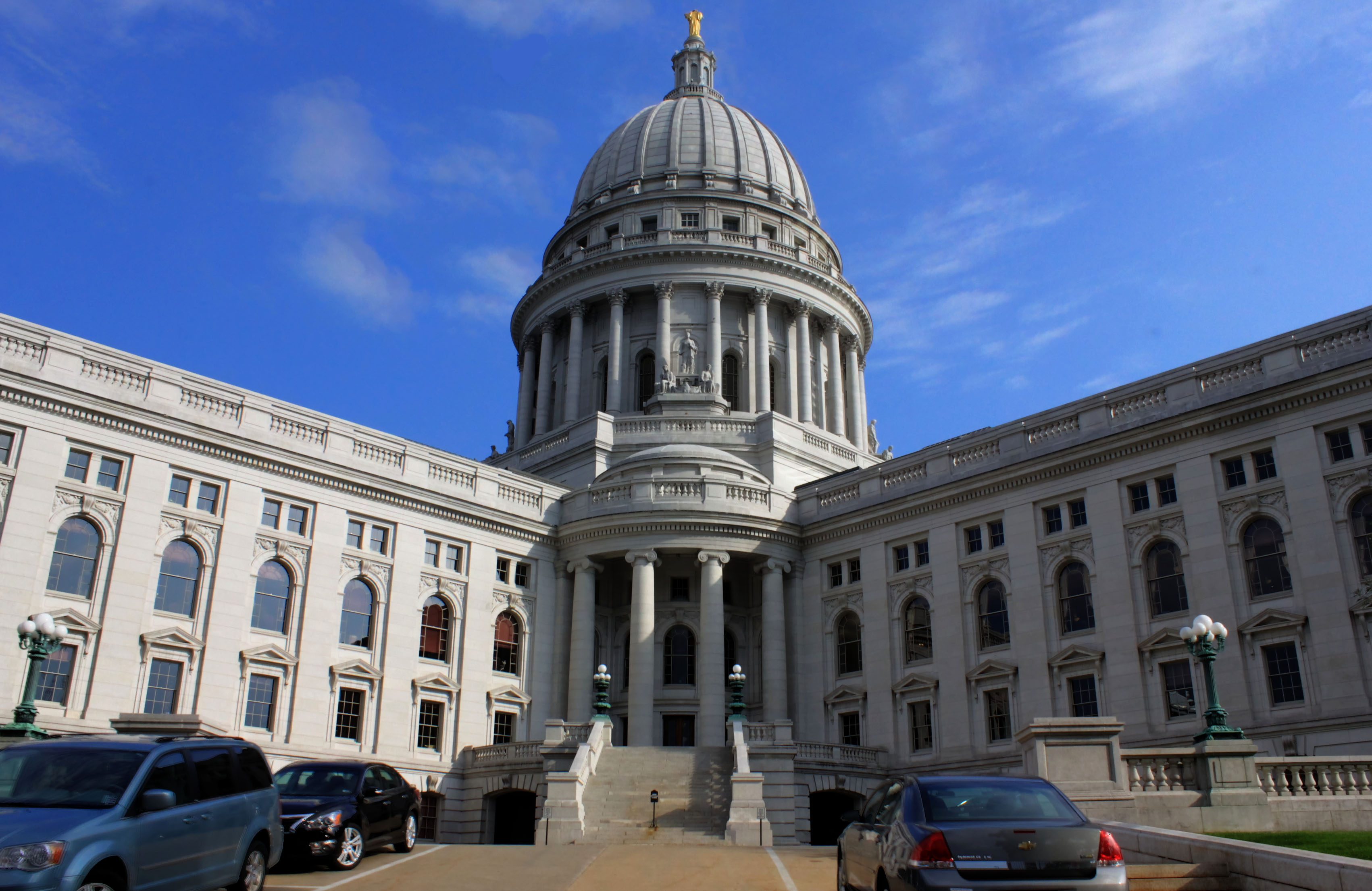
Photograph: Yinan Chen, Wisconsin State Capitol, September 19, 2013 ↗