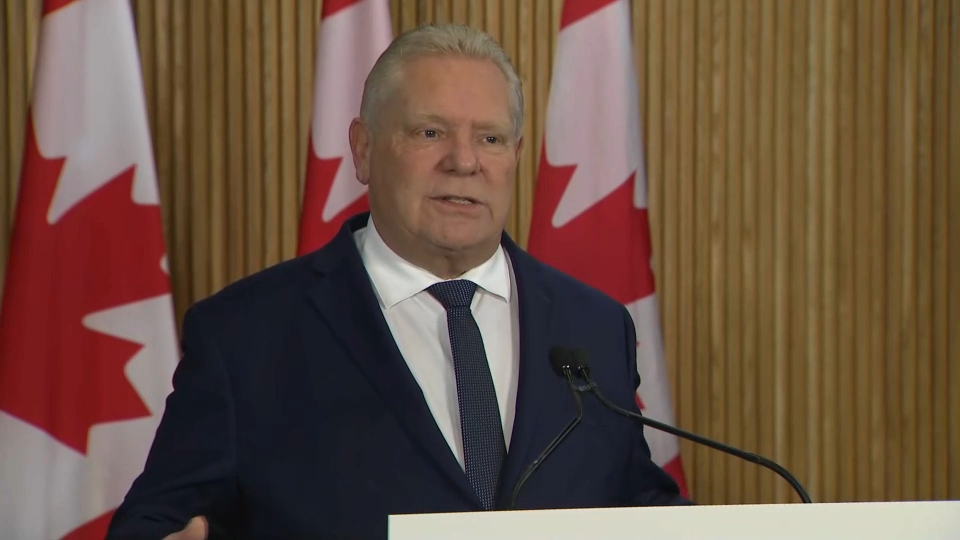
Ford proposes tariffs aimed at eight Republican-leaning states
TORONTO — The economic consequences of President Donald Trump’s escalating trade confrontation with Canada could soon be felt most sharply in states that helped return him to the White House.
Ontario Premier Doug Ford has urged Canadian Prime Minister Mark Carney to impose additional retaliatory tariffs on products originating in eight states considered politically important to Trump and his Republican base: Alabama, Arkansas, Florida, Iowa, Missouri, Montana, Texas and Wisconsin.
“Products from these states should face the full force of Canada’s response,” Ford wrote in an August 17 letter to Carney. The proposal is more politically targeted than an across-the-board tariff because it seeks to place pressure in communities where economic pain could produce political consequences for the administration.
What the viral social-media claim gets right — and wrong
A viral graphic says Ford declared, “The red states, we’re going to hit hard,” and claims that whiskey, oranges, cars and appliances are all on a finalized retaliation list. The central premise is real, but the wording and product list combine confirmed information with claims that go beyond Ford’s documented statement.
The verified language from Ford’s letter says products from the eight named states should face the “full force” of Canada’s response. The phrase attributed to him in the graphic does not appear to be a verified direct quotation.
Canada has announced plans to impose tariffs on U.S. steel, dairy products, appliances, agricultural equipment, pulp and paper, and electronics beginning September 8. Ottawa has not yet released every product that will be covered, so social-media lists should not be treated as final government policy.
Canada prepares a dollar-for-dollar response
Ford called for a coordinated “dollar-for-dollar, tariff-for-tariff response” after negotiations between Washington and Ottawa collapsed and the United States imposed 50% tariffs on approximately $20 billion in Canadian exports.
Prime Minister Mark Carney has confirmed that Canada will retaliate beginning September 8. The Canadian measures will answer new U.S. duties affecting products including wine, furniture, dairy, cement, clothing, fishing rods and hockey equipment.
“We cannot back down in the face of economic coercion,” Ford wrote. “Capitulation in response to Section 338 tariffs will only weaken Canada’s position. We must remain strong.” Whether Carney’s government will adopt Ford’s state-by-state targeting proposal remains unresolved.
Trump threatens new 50% automotive tariffs
The dispute intensified Monday when Trump threatened to raise tariffs on Canadian cars, trucks and automotive parts to 50% beginning January 1, 2027. The announcement is a threat and has not yet taken effect.
The United States and Canada share one of the world’s most integrated automotive supply chains. Vehicle components can cross the border several times before a finished automobile reaches a dealership, meaning tariffs can raise expenses for American factories as well as Canadian exporters.
Shares of Ford Motor Company fell 3.6%, Stellantis dropped 4.2%, General Motors declined 1.6% and Toyota fell 1.5% during Monday trading after Trump’s announcement, according to Reuters. Industry executives also noted that some previous tariff threats were later delayed, reduced or abandoned.
American importers pay tariffs at the border
Trump frequently describes tariffs as money paid by foreign governments. In practice, U.S. importers pay the tariff when affected products enter the country. Those businesses must absorb the expense, find different suppliers or pass some of the cost to customers.
Canada does not escape the consequences. Canadian manufacturers can lose orders, reduce production or eliminate jobs when their products become more expensive in the United States. A prolonged trade war therefore threatens workers, companies and consumers on both sides of the border.
Canada sends roughly three-quarters of its exported goods to the United States. American businesses, meanwhile, depend on Canadian steel, aluminum, lumber, energy and automotive components. That interdependence makes it difficult to inflict economic pain on one country without creating costs in the other.
Electricity and critical minerals are also on the table
Ford has warned that Canada could escalate beyond tariffs if Trump continues targeting Canadian industries. Ontario provides electricity to approximately 1.5 million American homes and businesses, and Ford said the province could raise prices or stop sending power south.
“Everything’s on the table. I’ll do whatever it takes,” Ford told the Associated Press. He also identified energy and critical minerals as possible leverage because those materials are important to American manufacturing and national security.
Ontario previously imposed a 25% surcharge on electricity exported to Michigan, Minnesota and New York during an earlier phase of the dispute. Trump responded by threatening to double steel and aluminum tariffs before both sides backed away from their measures.
A strategy designed to reach Trump’s voters
Ford’s proposal would turn an abstract dispute between national governments into a visible economic issue inside Republican communities. Producers and manufacturers in the eight named states could lose Canadian customers or face new costs if Ottawa adopts the plan.
Whether that pressure would persuade Trump to reverse course is uncertain. It could instead produce another round of U.S. retaliation, deepening the confrontation and increasing the financial damage on both sides.
What is clear is that Ford wants the political consequences of the trade war to reach the president’s base directly. Canada’s final tariff schedule will determine how closely Ottawa follows that strategy—and which American industries ultimately feel the effects.
Sources and further reading
iPolitics: Ford’s August 17 letter urges targeted retaliation ↗
Reuters: Canada announces dollar-for-dollar retaliatory tariffs ↗
Reuters: Trump threatens 50% tariffs on Canadian vehicles and parts ↗
Associated Press: Ford says electricity and critical minerals are on the table ↗