California has cases, but Kern reports no known local impact
BAKERSFIELD, Calif. — California is among 17 states with illnesses in a Salmonella Enteritidis outbreak linked in part to recalled shell eggs, but Kern Public Health says it has not been notified of a case connected to the outbreak or of recalled product shipped into the county.
The FDA's July 24 update lists 98 illnesses, 26 hospitalizations and no deaths. Illnesses began between November 21, 2025, and June 30, 2026. California appears on the federal case list, while the confirmed product-distribution states are Arkansas, Louisiana, Mississippi, New Mexico, Oklahoma and Texas.
Those two facts are not contradictory. A person can become sick after traveling, eating outside the state or encountering a product moved through secondary distribution. The FDA also cautions that confirmed distribution information may be incomplete.
How to identify the recalled cartons
Midwest Poultry Services recalled 1,589,577 dozen white shell eggs and brown cage-free shell eggs produced in Texas. The affected eggs were distributed between June 6 and July 3 and carry sell-by or best-by dates from July 20 through August 17, 2026.
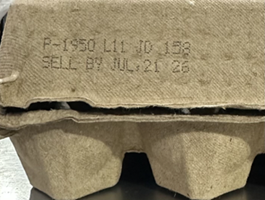
The recall covers Country Morning, Cal-Maine Sunups, Brookshire's, Simple Truth and Kroger products in packages ranging from six to 60 eggs. Only cartons marked with plant code P-1950 or 0840962 and a Julian date from 157 through 184 are included.
The code appears in date-coding ink on the side of the carton. Brand name alone is not enough to identify a recalled package, and no other Midwest Poultry Services products are included in the company's announcement.
What consumers should do
Do not eat, sell or serve eggs that match the recalled codes. The FDA and CDC advise throwing them away or returning them to the place of purchase, then cleaning and sanitizing any refrigerator shelf, container, utensil or surface the eggs touched.
If eggs were removed from their original carton and cannot be identified, the FDA recommends discarding them. Hands, utensils and surfaces should be washed with hot, soapy water before and after handling raw eggs or foods containing them.
The sell-by dates have passed, but stored eggs can remain in refrigerators. The practical value of checking now is finding an old carton before someone cooks or serves it—not assuming every egg currently sold in Bakersfield is affected.
Symptoms and when to seek care
Salmonella commonly causes diarrhea, fever and stomach cramps. Symptoms usually begin 12 to 72 hours after exposure and often last four to seven days, according to federal health guidance.
Children younger than 5, adults 65 and older and people with weakened immune systems face a greater risk of severe illness. The CDC says people should promptly contact a health-care provider for bloody diarrhea, diarrhea lasting more than two days without improvement, fever above 102 degrees, repeated vomiting that prevents fluid intake or signs of dehydration.
Most people recover without antibiotics. CDC investigators found that the outbreak strain may resist some antibiotics, however, so treatment decisions should be made by a clinician rather than through self-medication.
What the investigation has—and has not—established
Epidemiological interviews found that 40 of 44 sick people with available food histories reported eating eggs. Genetic testing also matched some Salmonella samples collected at the producer's Texas farms to the outbreak strain.
Federal investigators call the recalled eggs a likely source for part of the outbreak, not the explanation for every case. The producer said it identified the issue through environmental monitoring and was not aware of specific illnesses linked to its products when it announced the recall.
Kern County's statement is reassuring but limited: no known local case or shipment is not proof that exposure is impossible. Residents should check cartons against the official codes, especially after travel or if eggs were obtained through an uncertain supply chain, and rely on dated FDA or CDC updates rather than generalized social posts.
Sources and further reading
FDA: Salmonella outbreak investigation and recalled-product codes ↗
FDA: Midwest Poultry Services recall announcement and product list ↗
CDC: Recalled shell eggs, symptoms and consumer guidance ↗
23ABC: Kern Public Health reports no known local cases or direct shipments ↗